
Blocking Chinese Drones and Expanding Drone Industry, U.S. Defense Market Opens for ‘K-Drones’
2026.05.19 20:39
As the Russia-Ukraine war and conflicts in the Middle East have unfolded, drones have emerged as a core force in the U.S. defense industry
Small unmanned aircraft budget expanded to $2.5 billion… market projected to reach $14.1 billion by 2033
Stronger regulations on Chinese drones… opportunities for Korean companies with “security reliability”
KOTRA supports North American expansion of 10 K-drone companies at Detroit exhibition
Reporter Hwang Bok-hee Entered 2026.05.18 16:13 Revised 2026.05.18 18:23
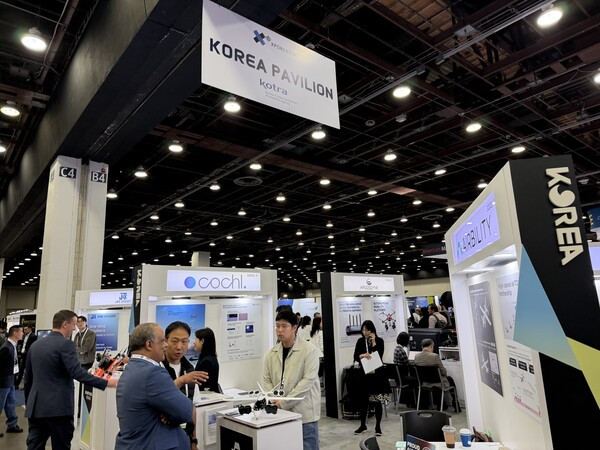
KOTRA operated the Korean Pavilion featuring 10 K-drone companies at “Xponential 2026,” the world’s largest unmanned systems exhibition held in Detroit, U.S., for four days starting May 11. Photo of the Korean Pavilion.
Demand for drones is rapidly increasing in the U.S. defense market following the Russia-Ukraine war and conflicts in the Middle East. As the nature of warfare is being reorganized around unmanned systems, the U.S. government has significantly increased its budget for securing small defense drones and strengthened regulations on Chinese drones, creating new market opportunities for Korean drone companies with “security reliability.”
The Korea Trade-Investment Promotion Agency (KOTRA) announced on the 17th that it operated a Korean Pavilion at “Xponential 2026,” the world’s largest unmanned mobility exhibition recently held in Detroit, U.S., where 10 domestic drone companies participated. Through this exhibition, KOTRA explored possibilities for entering the U.S. defense and public markets and sought to identify local buyers.
U.S. Drone Demand Expanded by War… Defense Budget Increased 25 Times
According to KOTRA, the U.S. drone market is expected to grow at an average annual rate of 9.2% after 2024 and reach $14.1 billion by 2033. In particular, the U.S. Congress significantly increased the budget for securing small unmanned aircraft systems (sUAS) for security and public purposes from less than $100 million in the past to $2.5 billion in 2025. This reflects the surge in military demand as drones have become key weapons in modern warfare beyond reconnaissance and surveillance.
In the Russia-Ukraine war, low-cost drones were actually used for tank and artillery strikes as well as real-time reconnaissance, changing battlefield operations. In conflicts in the Middle East as well, drones and suicide unmanned aircraft were used as key military assets. KOTRA analyzed that these wartime experiences are driving increased drone demand in North America and Europe.
As the U.S. Blocks Chinese Drones… ‘Alternative Supply Chains’ Emerge
The biggest change in the U.S. defense market is the reorganization of supply chains. The U.S. Federal Communications Commission (FCC) is strengthening regulations on the sale of drones and core components from certain countries due to security concerns. In particular, as the “American Security Drone Act,” which restricts the purchase of Chinese drones using federal funds, is being fully implemented, securing trustworthy alternative supply chains has emerged as a key task in the public and defense sectors.
As a result, demand is increasing in the U.S. market for drones with strong security and data safety features. Korean companies participating in the exhibition also emphasized “security reliability” and sought opportunities for cooperation with defense and public institutions. Through KOTRA, an official from a U.S. drone distribution company commented, “Inquiries about Korean drones recognized for their security are rapidly increasing.”
U.S. Department of Defense Pushes ‘Replicator’… K-Drones Put to the Test
Attention is also being paid to the “Replicator” project promoted by the U.S. Department of Defense. It is a project aimed at deploying large numbers of low-cost, high-performance unmanned systems and is considered one of the key policies increasing drone demand across the U.S. defense ecosystem. KOTRA expects opportunities for K-drone companies that possess both technological capability and security reliability to expand further.
However, as the U.S. defense market has strict certification and security standards, there are still high barriers such as “Green UAS” and “Blue UAS” approvals before actual entry into the supply chain can be achieved. KOTRA stated that it also sought certification support partners in the U.S. during the exhibition period and that a total of 88 consultations were conducted during the event.
Source: Overseas Koreans Newspaper (https://www.dongponews.net)